


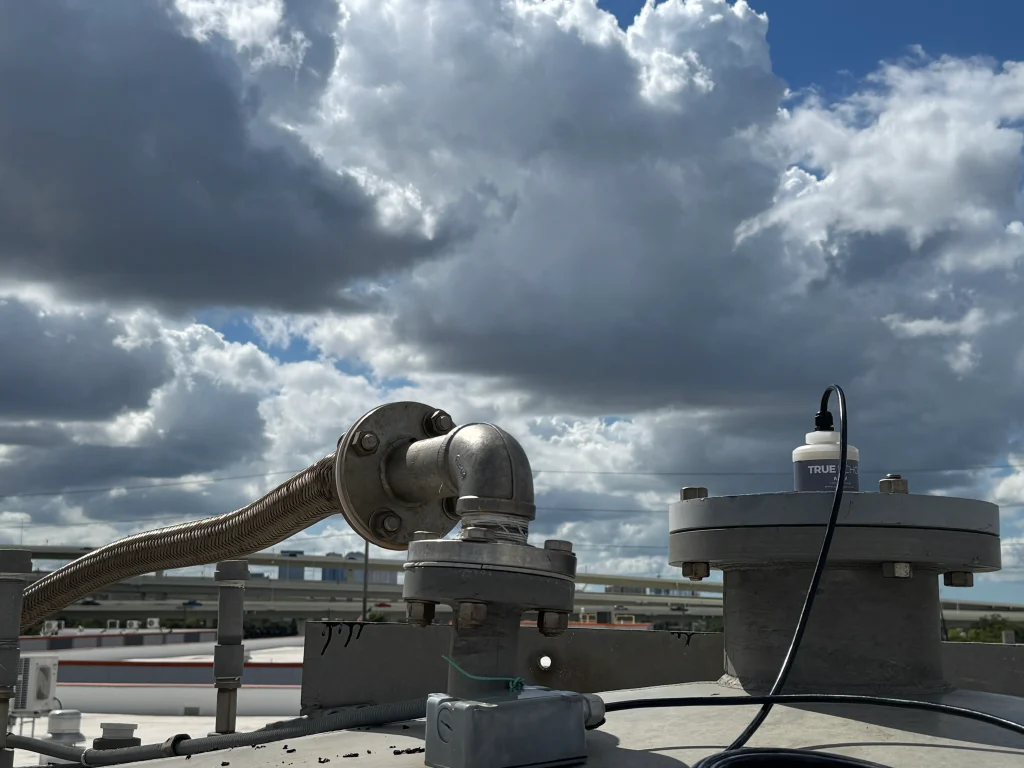
Level sensors can be classified in two basic ways: contact level sensors and non-contact level sensors. Simply put, contact sensors physically touch the media being measured, while non-contact sensors measure level from a distance. While contact level sensors are reliable means of level measurement, a non-contact equivalent often provides better long-term performance, reduced maintenance, and improved reliability, especially in challenging environments. At Automation Products Group, Inc. (APG), our non-contact sensors are designed to give you accurate, reliable measurements from a distance.
Types of Non-Contact Sensors
Non-contact level sensors include two main types: ultrasonic sensors and radar sensors.
Ultrasonic sensors use sound waves. As the sensor emits the sound waves, they bounce off the target and return to the transmitter. How long it takes for the sound waves to reflect back determines the level measurement.
Radar sensors use electromagnetic waves, which are faster than sound waves, to determine level measurement. They aren’t as affected by temperature differences, making them more accurate than ultrasonic sensors.
For applications, here are three reasons why you should consider a non-contact sensor for level measurement.
Low Maintenance
In dirty applications, media build-up can affect the performance of a float, probe, or submersible sensor. Non-contact sensors stay well above the mix and require much less maintenance. Contact sensors also face debris and turbulence, which can damage a sensor. Non-contact sensors don’t have this problem.
In the food and beverage industry, non-contact sensors reduce the risk of product contamination. By taking measurements without submersing a sensor into the product itself, companies can ensure that their product is free from contamination with greater ease than a contact sensor.
Longer Sensor Life
Non-contact sensors are free from mechanical moving parts often found in floats and probes, and they don’t constantly rest inside the material being measured. This greatly reduces the general wear and tear from simple operation. In addition, only vaporous chemicals are capable of causing corrosion.
Easy Installation
Contact sensors vary in size and weight. Some of them are difficult to ship and install. Level probes can be long, heavy, and require a lift to install on a tank. Non-contact sensors are relatively small and lightweight in comparison—typically fitting into an NPT fitting of 3 inches or less. This makes installation much easier and less expensive, speeding up implementation. The smaller non-contact sensors require less packaging, reducing shipping costs.
A Great Tool
These benefits have made non-contact sensors extremely popular for many applications. They can reduce installation, maintenance, and replacement costs while improving performance.
Applications for Non-Contact Sensors
There are several applications for non-contact sensors.
- Tank Level Monitoring
- Car Wash systems
- Food and Beverage processing
- Water and Wastewater treatment
- Oil and Gas operations
Make The Switch To A Non-Contact Sensor
Do you have any questions about using non-contact sensors? Tell us about your application! You can also give us a call and speak with our Measurement Experts.
WRITTEN BY

Sami T.
Sami Thompson is APG’s Marketing Technical Writer and has been with the company since 2022. With a master’s degree in English from Utah State University and a 40-page thesis publication under her belt, Sami has a demonstrated strong writing background. In her free time, Sami enjoys reading and birdwatching.